Whatsapp:+86 18339211009 Address: 1000 meters west of the gate of Yanjin County Forest Park, Xinxiang City, Henan Province.
Screw Conveyor can be classified into various types based on different materials, angles, structures, and applications. Each type has specific application scenarios and design considerations. The core principle is to continuously push materials along the inside of the casing using rotating helical blades, achieving horizontal, inclined, or vertical conveying. Our factory produces screw conveyors, each model of which supports customization and can easily handle the conveying of powdery, granular, fragile, sticky, high-temperature, or corrosive materials. Different types of screw conveyors have their own unique characteristics, providing high-speed and reliable solutions for diverse industrial scenarios.
This is the most basic classification method for screw conveyors, with the core difference lying in the rigidity of the conveying pipe/shaft, adapting to different installation and operating environments.
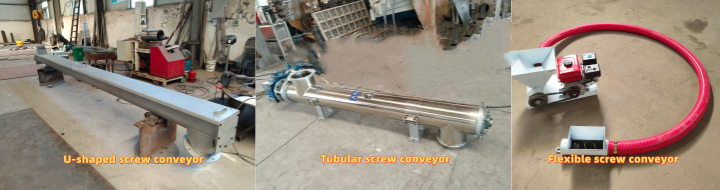
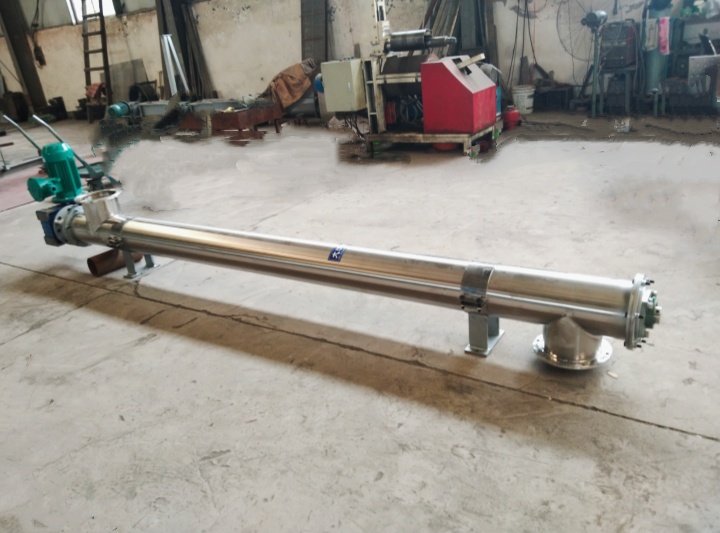
Tubular Screw Conveyor: The conveying channel is a closed circular steel pipe. Materials are conveyed in a sealed manner within the pipe, effectively preventing dust leakage, material dampness, or contamination. It is particularly suitable for powders and fine granular materials. The single unit length is usually 2-30 meters, and some models can achieve longer distance conveying through flange connections.
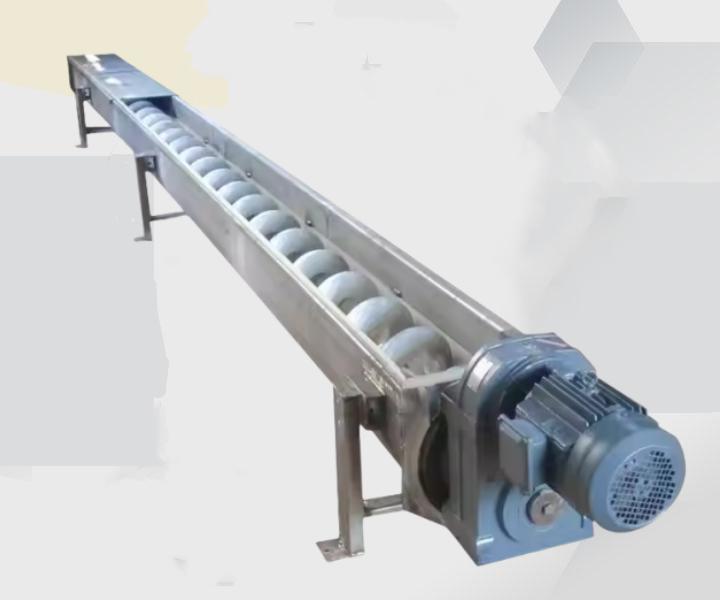
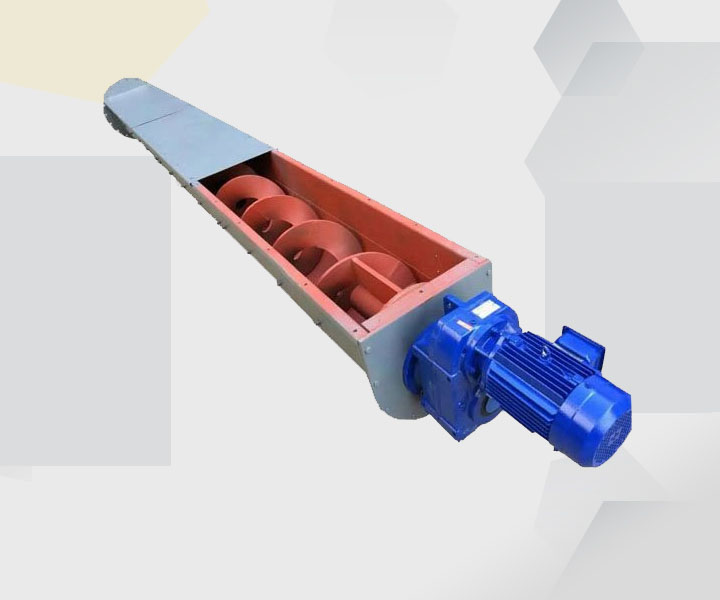
Trough Screw Conveyor: The conveying channel is a U-shaped open trough. A cover plate can be added on top as needed, facilitating observation of the material conveying status and making cleaning and maintenance convenient. This model is suitable for conveying bulk and granular materials, especially those that tend to clump together and require regular cleaning.
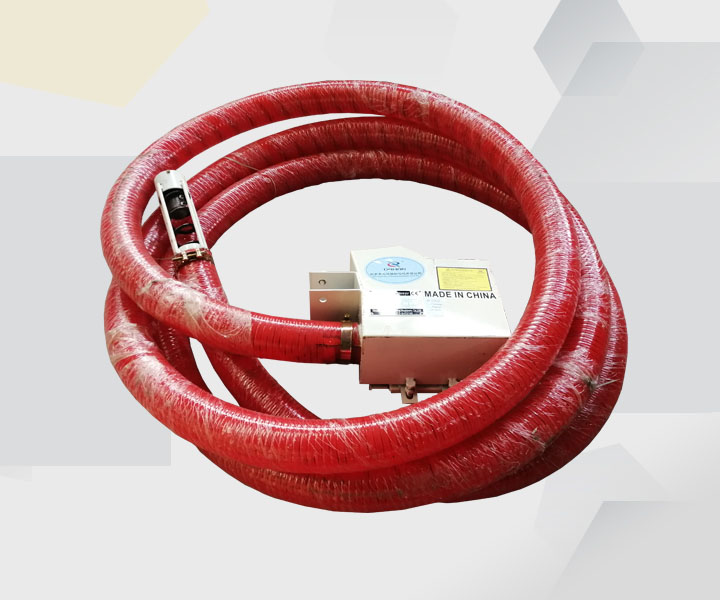
Flexible screw conveyor: The core feature is the use of a flexible conveying tube and a flexible screw shaft, resulting in strong overall flexibility and the ability to bend flexibly, adapting to conveying needs in confined spaces or complex layouts. Commonly used for the transfer of materials such as grains, plastic granules, and food raw materials.
Based on the spatial direction of material conveying, screw conveyors can be divided into horizontal, inclined, and vertical types. The core difference lies in the design of the screw blades and power configuration to cope with the gravitational resistance of materials in different directions.
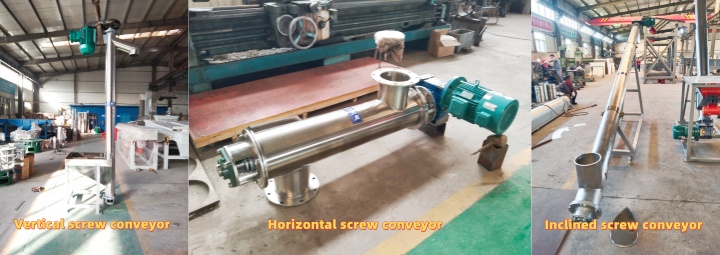
Horizontal screw conveyor: The conveying direction is parallel to the horizontal plane. It is the most widely used model, with the least material conveying resistance and the highest efficiency. It supports conveying distances of 1-30 meters and can convey various materials such as powders, granules, and small lumps.
Inclined screw conveyor: The conveying direction forms an angle of 0-45° with the horizontal plane. It is mainly used to connect equipment at different heights, saving workshop space. It is suitable for conveying materials with moderate viscosity and those that do not easily clump together. The larger the angle, the lower the conveying efficiency.
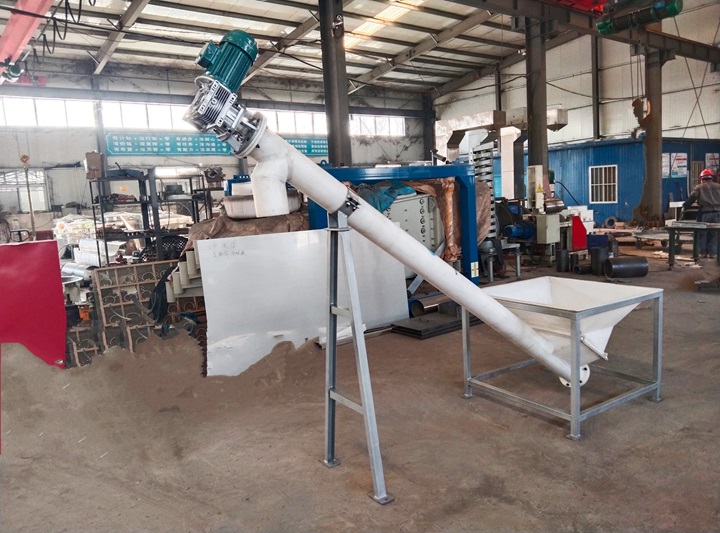
Vertical screw conveyor: The conveying direction is perpendicular to the horizontal plane. It is mainly used for vertically lifting materials, maximizing the use of vertical space. It is suitable for material lifting needs in confined spaces. The vertical height can reach 6 meters, and it is suitable for conveying fine granular and powdery materials.
Screw conveyors can be divided into two types based on their structural characteristics: shafted and shaftless. Each model can easily adapt to different materials and scenarios.
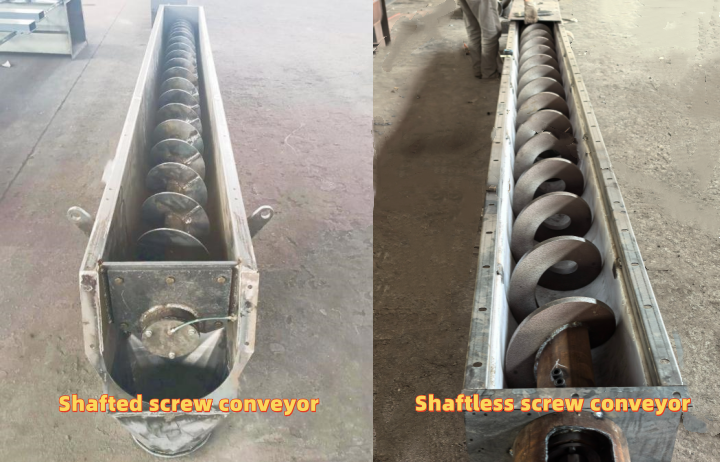
Shafted screw conveyor: Uses a rigid... Screw conveyors move materials through the rotation of a helical screw, with blades welded or bolted to the shaft. Their stable structure makes them suitable for conveying non-viscous dry powders and small granular materials. This type of conveyor is sensitive to overloading and prone to clogging due to material clumping, requiring regular cleaning of the screw shaft and hanger bearings.
Shaftless screw conveyor: This type eliminates the traditional central shaft, directly propelling materials through the rotation of the helical blades. Its core advantage lies in its ability to convey viscous and easily entangled materials such as sludge, biomass, and waste.
Screw conveyors can be classified by functional extension into explosion-proof, water-cooled, and twin-screw types, matching the needs of special working conditions and comprehensively covering personalized conveying scenarios in chemical, metallurgical, building materials, and other industries.
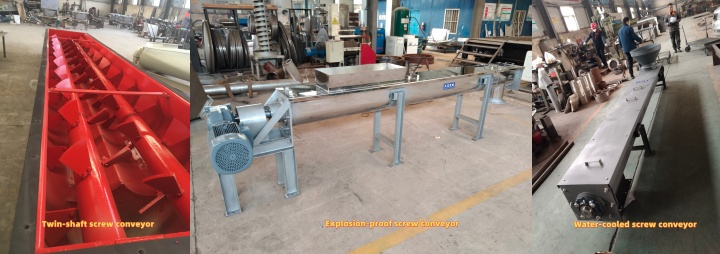
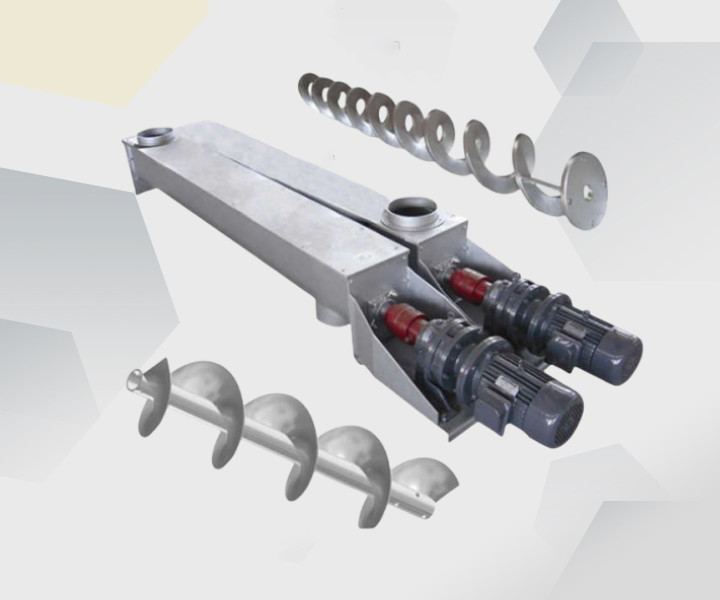
Twin-screw conveyor: This type combines mixing and conveying through the combination of two helical blades. Its typical structure includes a pre-watering section, allowing for simultaneous material mixing during the conveying process. It is suitable for materials with poor fluidity that require uniform mixing.
Explosion-proof screw conveyor: Designed specifically for conveying flammable and explosive materials, its core components include explosion-proof motors, explosion-proof reducers, and anti-static devices. All electrical components meet explosion-proof standards. The equipment adopts a fully enclosed tubular structure to reduce electrostatic sparks generated by friction between the material and the pipe wall, effectively mitigating the risk of explosion.
Water-cooled screw conveyor: Customized for high-temperature material conveying scenarios, the machine body is equipped with a water-cooled jacket structure. Circulating cooling water removes the heat absorbed during equipment operation, meeting the high-temperature material transfer needs of industries such as metallurgy, building materials, and thermal power generation.
Screw conveyors can be classified by the core material of the machine body into carbon steel, stainless steel, and PP. There are three main types of materials: carbon steel models offer high cost-effectiveness, stainless steel models are corrosion-resistant and hygienic, and PP material models are specifically designed for acidic and alkaline materials.
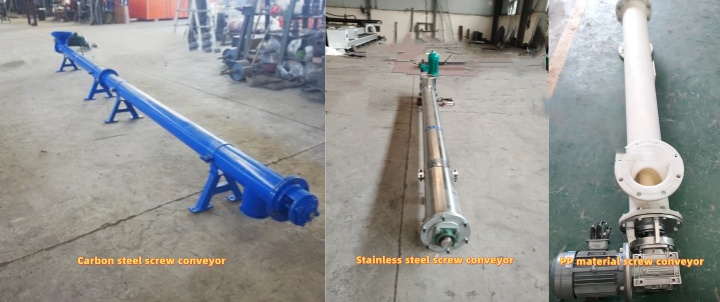
Carbon steel screw conveyor: The machine body and screw blades are made of carbon steel, offering high structural strength and strong load-bearing capacity, with lower production costs and outstanding cost-effectiveness. Suitable for conveying dry, non-corrosive materials, widely used in industries such as building materials, mining, and feed processing, where corrosion resistance is not a primary requirement.
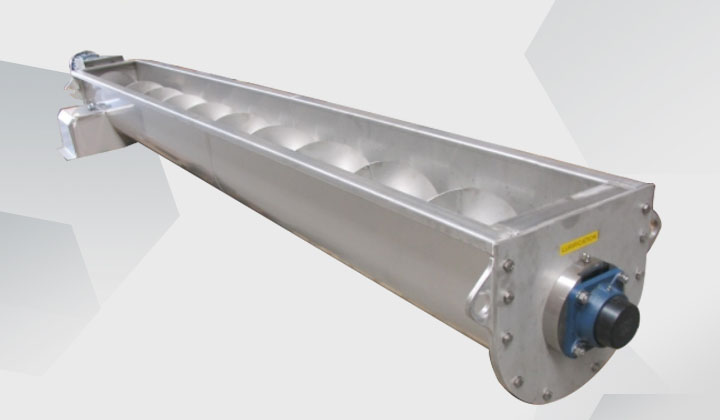
Stainless steel screw conveyor: The core components are made of 304/316 stainless steel, possessing excellent corrosion resistance and hygiene. The smooth surface prevents material adhesion and facilitates cleaning and disinfection. Suitable for conveying corrosive chemical powders, food raw materials, pharmaceutical raw materials, and other materials.
PP material screw conveyor: The machine body is made of polypropylene, which has extremely strong acid and alkali corrosion resistance, is lightweight, and low in cost. Suitable for conveying strong acid and alkali chemical liquids or powder materials. However, PP... The material's high-temperature resistance and structural strength are weak, making it only suitable for conveying scenarios at normal temperatures and under light loads.
Choosing a screw conveyor requires prioritizing material compatibility, combined with comprehensive consideration of conveying needs, equipment parameters, operating environment, and cost factors. Flexible models are suitable for space-constrained scenarios. By matching the requirements, equipment efficiency can be significantly improved and service life extended.
Determine material characteristics: Material type, state, and physical properties are the primary basis for selecting a screw conveyor. Powdered/granular materials are suitable for shafted models, viscous/easily tangled materials require a shaftless design, and large or fragile materials require low-speed or food-grade models.
Consider conveying needs: Conveying direction, distance, quantity, and speed are key decision factors. Horizontal conveying uses conventional models, vertical lifting requires a dedicated vertical screw conveyor, and inclined conveying exceeding 20° requires adjustment of the screw speed or blade design; high-capacity production lines require large-diameter models to avoid overloading.
Determine site conditions: Installation space, operating conditions, and maintenance requirements determine the suitability of the model. Space-constrained scenarios require flexible screw conveyors, and outdoor environments require rainproof and corrosion-resistant designs; prioritize models with easily replaceable wear parts and easy cleaning; for high automation requirements, select intelligent control devices such as frequency converters and sensors.
Dahan Machinery produces a full range of customizable screw conveyors. The core design is precisely adapted to the conveying direction, offering conventional horizontal models, angle-adjustable inclined models, and space-optimized vertical models, covering distances ≤30 meters, 30°-60° height differences, and 2-6... Vertical conveying scenario for rice. We offer customized solutions in carbon steel, stainless steel, and PP materials, equipped with variable frequency speed control, wear-resistant liners, and other accessories. Suitable for a variety of materials including powders, granules, and ores, we can design a suitable conveyor system tailored to your existing equipment to ensure the smooth operation of your entire production line.
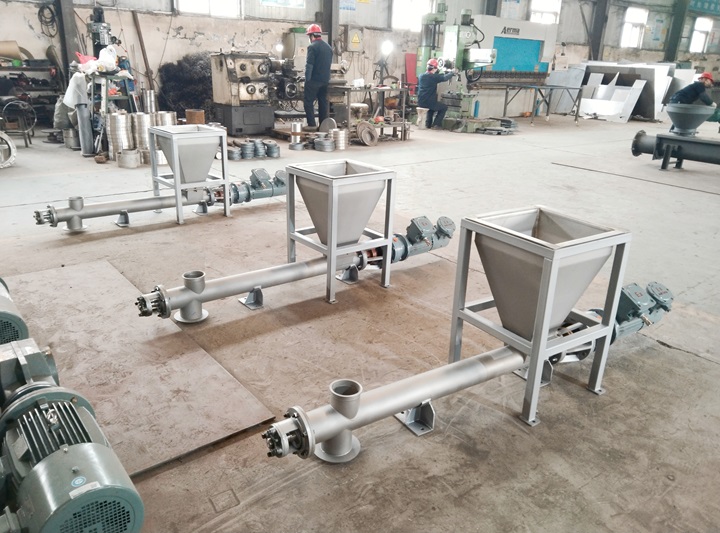
Screw conveyors come in various types, from basic horizontal/vertical conveying to innovative designs with or without shafts, and functional extensions such as double screws and explosion-proof features. Each generation of machine is optimized for specific industrial applications.
NOTE: You can also send a message to us by this email sale@xxdahan.com, we will reply to you within 24 hours. Now tell us your needs, there will be more favorable prices!